now hiring: Helpers, site engineers, account executives | ESI, EPF & Payroll compliance - 100% hassle free | trusted by 100+ companies across kerala | Helpers, site engineers, account executives

Labour Law Compliance & Workforce Management Services in India

Ensure 100% Statutory Compliance | Reduce Risk | Streamline Workforce Operations

BIOS provides end-to-end Labour Law Compliance, Labour Licence Assistance, Workforce Management, and Labour Issue Resolution Services in India.

We help businesses stay compliant with both existing Indian labour laws and the new Labour Codes framework, ensuring smooth operations, zero legal risk, and audit-ready systems.

Labour Law & Labour Codes Compliance in India

India’s labour law system is evolving with the introduction of Labour Codes, aimed at simplifying and consolidating multiple labour laws into a unified framework.

However, as the implementation of Labour Codes is still in progress across various states, businesses are required to comply with both existing labour laws and the upcoming Labour Codes.

fun-facts

Existing Labour Laws

EPF, ESI, Minimum Wages Act, Shops & Establishments Act, Payment of Bonus Act, Payment of Gratuity Act, Contract Labour Act (CLRA)

fun-facts

New Labour Codes

Code on Wages, 2019
Code on Social Security, 2020
Industrial Relations Code, 2020
Occupational Safety, Health & Working Conditions Code, 2020

We ensure complete statutory compliance while preparing your business for future Labour Code implementation

Our Labour Compliance Services

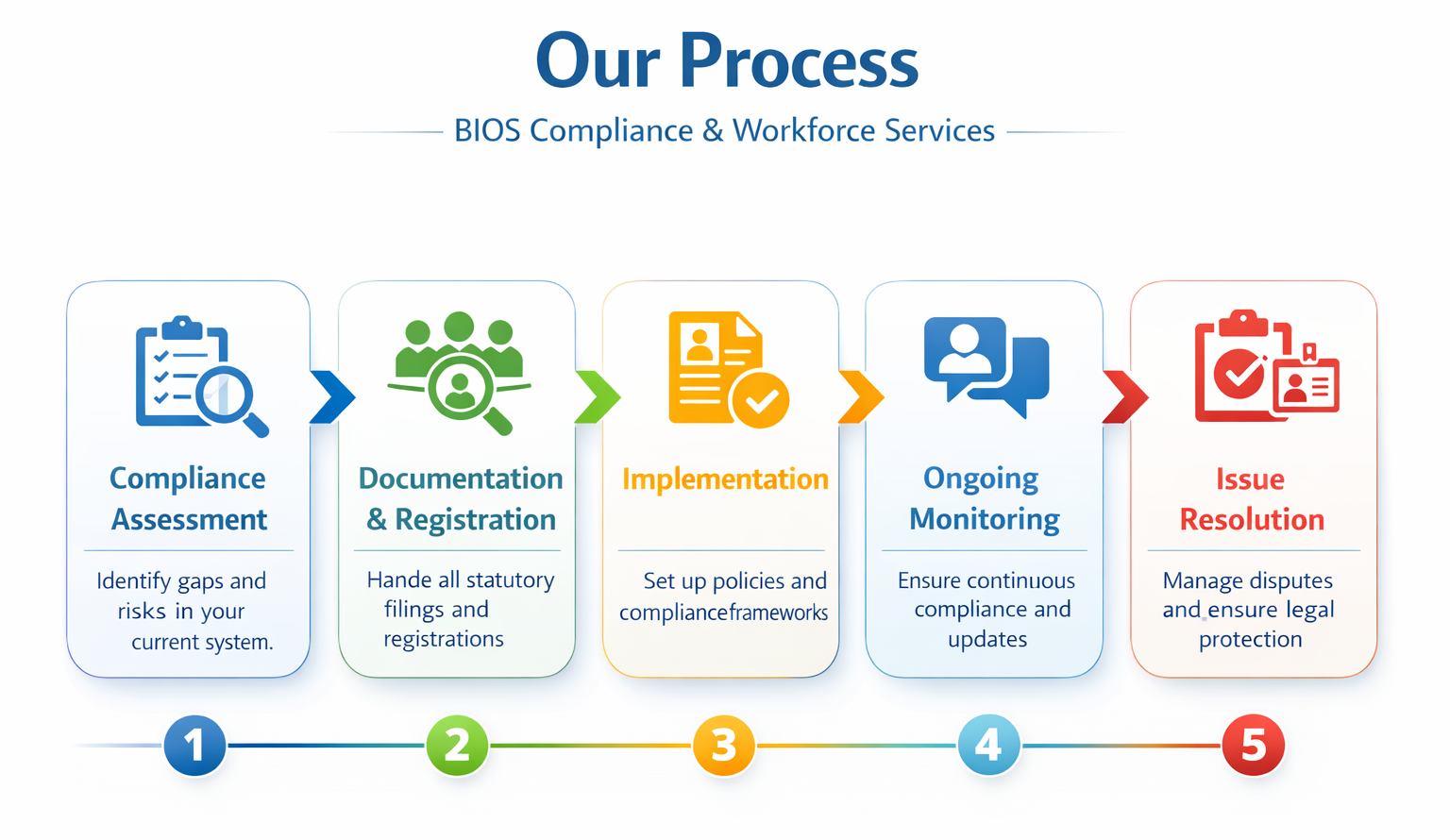
Labour Law Advisory & Compliance

Stay aligned with all statutory requirements and avoid penalties.

  • Labour law audits and compliance checks
  • HR policy drafting and employee documentation
  • Statutory registrations and filings
  • Ongoing compliance monitoring
  • Advisory on labour law updates
Labour Licence Registration & Renewal

Complete support for all required labour licences.

  • Contract Labour Licence (CLRA)
  • Shops & Establishment Licence
  • Factory Licence
  • New registrations and renewals
  • Documentation and approvals
Workforce Management Services

Improve workforce efficiency while maintaining compliance.

  • Workforce planning and allocation
  • Attendance and shift management
  • HR records and documentation
  • Payroll compliance coordination
  • Employee grievance handling
Labour Issue Resolution

Resolve workplace disputes efficiently and legally.
  • Wage and salary disputes
  • Employee grievances
  • Contract labour issues
  • Termination and disciplinary matters
  • Compliance-related conflicts
contract

Industries we serve

fun-facts

IT & ITES

fun-facts

Manufacturing & Industrial Units

fun-facts

FMCG & Retail

fun-facts

Healthcare & Pharmaceuticals

fun-facts

Construction & Infrastructure

fun-facts

Startups & Emerging Enterprises

contract

Why Choose BIOS?

  • Expert HR & Labour Law Professionals
  • End-to-End Compliance Solutions
  • Industry-Specific Customized Services
  • Up-to-Date Labour Law & Code Knowledge
  • Accurate Documentation & Timely Filings
  • Strong Audit & Inspection Support
FAQs - Labour Compliance & Workforce Services

Labour law compliance in India refers to following all statutory regulations related to employees, including EPF, ESI, minimum wages, labour licences, and workplace policies as mandated by government authorities.

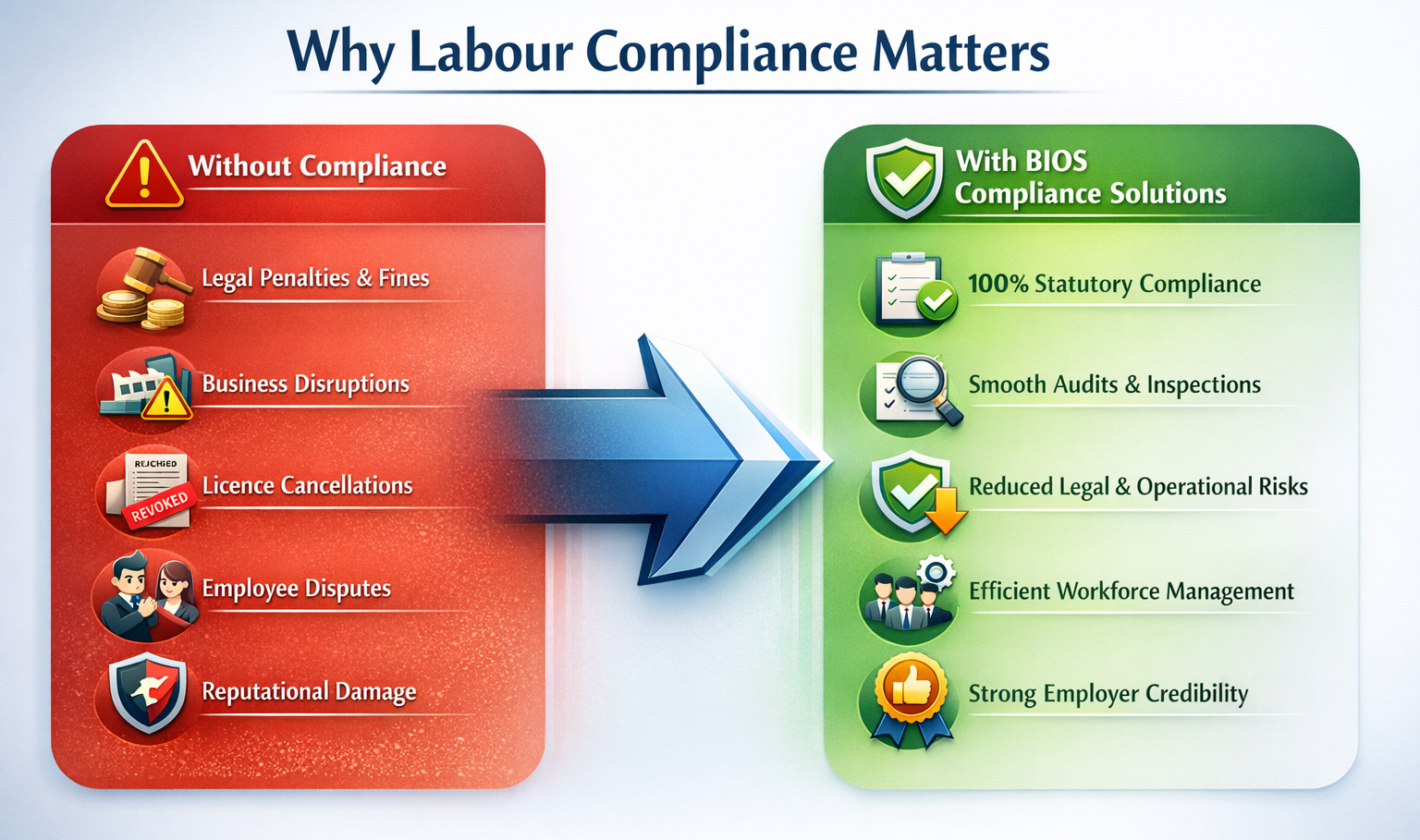
It helps businesses avoid penalties, legal disputes, and operational disruptions while ensuring employee rights, smooth audits, and a legally secure work environment.

Key laws include EPF, ESI, Minimum Wages Act, Shops & Establishments Act, Payment of Bonus Act, Gratuity Act, and Contract Labour Act (CLRA).

Yes, even startups and small businesses must comply with applicable labour laws based on employee count, industry, and operations.

Non-compliance can result in fines, legal notices, licence cancellation, employee disputes, and reputational damage.

The four labour codes are Code on Wages (2019), Code on Social Security (2020), Industrial Relations Code (2020), and Occupational Safety, Health & Working Conditions Code (2020).

Labour codes have been passed but are not fully implemented across all states. Businesses must comply with existing laws while preparing for the transition.

Labour laws are individual acts governing specific areas, while labour codes combine multiple laws into simplified, unified frameworks.

They will simplify compliance but require updates in payroll, HR policies, and employment structures.

Yes, until full implementation, businesses must comply with existing laws and stay prepared for labour codes.

EPF compliance involves deducting and contributing a portion of employee salaries to the Provident Fund as per statutory requirements.

ESI is a social security scheme providing medical and financial benefits to eligible employees based on salary thresholds.

EPF is mandatory for companies with a specified number of employees, as per government norms.

Yes, if the company meets employee count and wage criteria defined under ESI regulations.

Penalties include fines, interest charges, and possible legal action by authorities.

A labour licence is a legal authorization required for employing contract labour or operating certain types of establishments.

Businesses employing contract workers or operating under specific regulatory frameworks must obtain a labour licence.

The application involves submitting required documents, forms, and fees through the respective state labour department.

Documents include business registration proof, employee details, contractor agreements, and statutory forms.

It depends on the state and licence type, but typically takes a few weeks with proper documentation.

Labour management involves planning, monitoring, and managing workforce productivity while ensuring legal compliance.

By obtaining a contract labour licence, maintaining records, ensuring wage compliance, and following statutory rules.

Rules include wage payment, working conditions, statutory benefits, and compliance with the Contract Labour Act.

Through proper workforce planning, attendance tracking, clear policies, and compliance-driven HR practices.

By following proper HR policies, maintaining documentation, and resolving issues through mediation and legal compliance.

Common issues include wage disputes, compliance gaps, employee grievances, and documentation errors.

Through internal resolution, mediation, or legal processes under labour laws.

HR ensures proper implementation of labour laws, documentation, employee policies, and compliance monitoring.

It is a detailed review of a company’s compliance with labour laws and statutory requirements.

Maintain proper records, ensure timely filings, follow statutory rules, and conduct regular internal audits.

Request a free quote

appoinment
View RTL View LTR